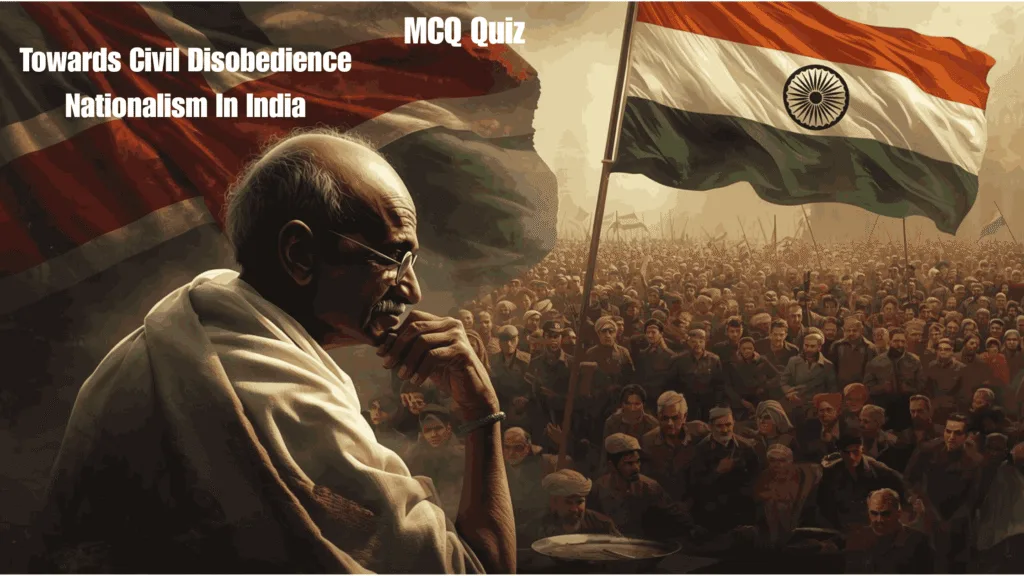
“MCQ The Movement in the Town – Nationalism In India Class 10” is the 6th instalment of the topic wise series of MCQs Quiz on Nationalism In India. All the questions are strictly based on NCERT book chapter on Nationalism In India class 10.
The current MCQs Quiz of 10 Questions is based on the subtopic –“The movement in the towns” of the main topic Differing Strands within the Movement.
Also Read| Explanantion- Nationalism In India
Before attempting the quiz please go through The MCQs on which the quiz is based. This will help you to score good marks.
Or, you can directly jump to the MCQ Quiz section by clicking to the table of contents below.
MCQ The Movement in the Town – Nationalism In India
Here are the same questions with randomized answer positions:
- Which group mainly started the Non-Cooperation Movement in the towns?
A) Army officers
B) Middle class
C) Peasants
D) Industrial workers
Answer: B) Middle class
Explanation: The movement in towns began with participation from the middle class.
- What did students, teachers, and lawyers do during the movement?
A) Started new political parties
B) Demanded higher salaries
C) Left government schools/colleges, resigned, and gave up legal practices
D) Joined the British army
Answer: C) Left government schools/colleges, resigned, and gave up legal practices
Explanation: Thousands of students left institutions, teachers resigned, and lawyers quit their practices.
- In which province were council elections NOT boycotted?
A) Bombay
B) Bengal
C) Punjab
D) Madras
Answer: D) Madras
Explanation: Elections were boycotted in most provinces except Madras.
- Why did the Justice Party in Madras not boycott council elections?
A) They believed entering councils was a way for non-Brahmans to gain power
B) They feared violence
C) They had no leaders to organise boycott
D) They supported British rule
Answer: A) They believed entering councils was a way for non-Brahmans to gain power
Explanation: The Justice Party saw council entry as a path to power usually reserved for Brahmans.
- What happened to the import value of foreign cloth between 1921 and 1922?
A) It increased slightly
B) It doubled
C) It remained unchanged
D) It halved, dropping from Rs 102 crore to Rs 57 crore
Answer: D) It halved, dropping from Rs 102 crore to Rs 57 crore
Explanation: Foreign cloth imports fell dramatically in value during this period.
- What actions were taken against foreign goods during the movement?
A) They were stored for future use
B) They were given as gifts to officials
C) They were taxed more heavily
D) Foreign cloth was burnt, liquor shops picketed, and trade in foreign goods refused
Answer: D) Foreign cloth was burnt, liquor shops picketed, and trade in foreign goods refused
Explanation: These were the visible economic actions taken by protestors.
- What was the effect of the boycott on Indian textile production?
A) Only handlooms benefited, mills suffered
B) It declined due to lack of raw materials
C) Production in mills and handlooms went up
D) No effect was seen
Answer: C) Production in mills and handlooms went up
Explanation: As people switched to Indian cloth, domestic textile production increased.
- Why did the movement slow down in towns?
A) Because khadi was expensive and poor people couldn’t afford to boycott mill cloth long
B) Because foreign goods became cheaper
C) Because British offered reforms
D) Because Gandhi was arrested
Answer: A) Because khadi was expensive and poor people couldn’t afford to boycott mill cloth long
Explanation: Khadi’s high cost made sustained boycott difficult for the poor.
- What major problem arose with boycotting British institutions?
A) British closed all institutions
B) Alternative Indian institutions were slow to come up
C) People missed exams
D) No entertainment was available
Answer: B) Alternative Indian institutions were slow to come up
Explanation: For the boycott to work, Indian alternatives were needed — but they developed slowly.
- What happened as a result of the slow development of Indian alternatives?
A) New laws were passed
B) Foreign institutions were destroyed
C) People migrated to villages
D) Students and teachers returned to government schools, lawyers rejoined government courts
Answer: D) Students and teachers returned to government schools, lawyers rejoined government courts
Explanation: Without alternatives, people gradually went back to British-run institutions.
MCQ Quiz The Movement In The Town| Nationalism In India
🎉 Quiz Completed!
Keep learning!
Also Read| Short Notes – Nationalism In India
FAQs: MCQ Quiz The Movement In The Town-Nationalism In India
Q 1: Are these questions comprehensive enough for board exam preparation?
Answer: Yes, these questions cover the key aspects of the Non-Cooperation Movement that are frequently tested in board examinations. They address:
- Urban participation patterns (middle-class leadership, student-teacher-lawyer involvement)
- Economic impact (foreign cloth boycott, textile production changes)
- Regional variations (Madras exception, Justice Party’s stance)
- Movement limitations (cost of khadi, lack of alternatives)
Q2: How can I preppare the whole chapter?
Answer: Read the explanation and the short note on Nationalism In Indian class 10 published on our website. After through preparation of NCERT and the above said topics you will get good marks in the examination,