

“Short Notes Force And Laws Of Motion Class 9” is carved out from Chapter 8 FORCE AND LAWS OF MOTION. And this ensures the relevance of the below short notes for your exams.
We have remove the unncessary things from the textbook and have included only the most important and relevant keywords. You will find the simple short notes very easy to read, scan, memorize and retain.
FORCE
Definition
Force → Push, hit, or pull on an object
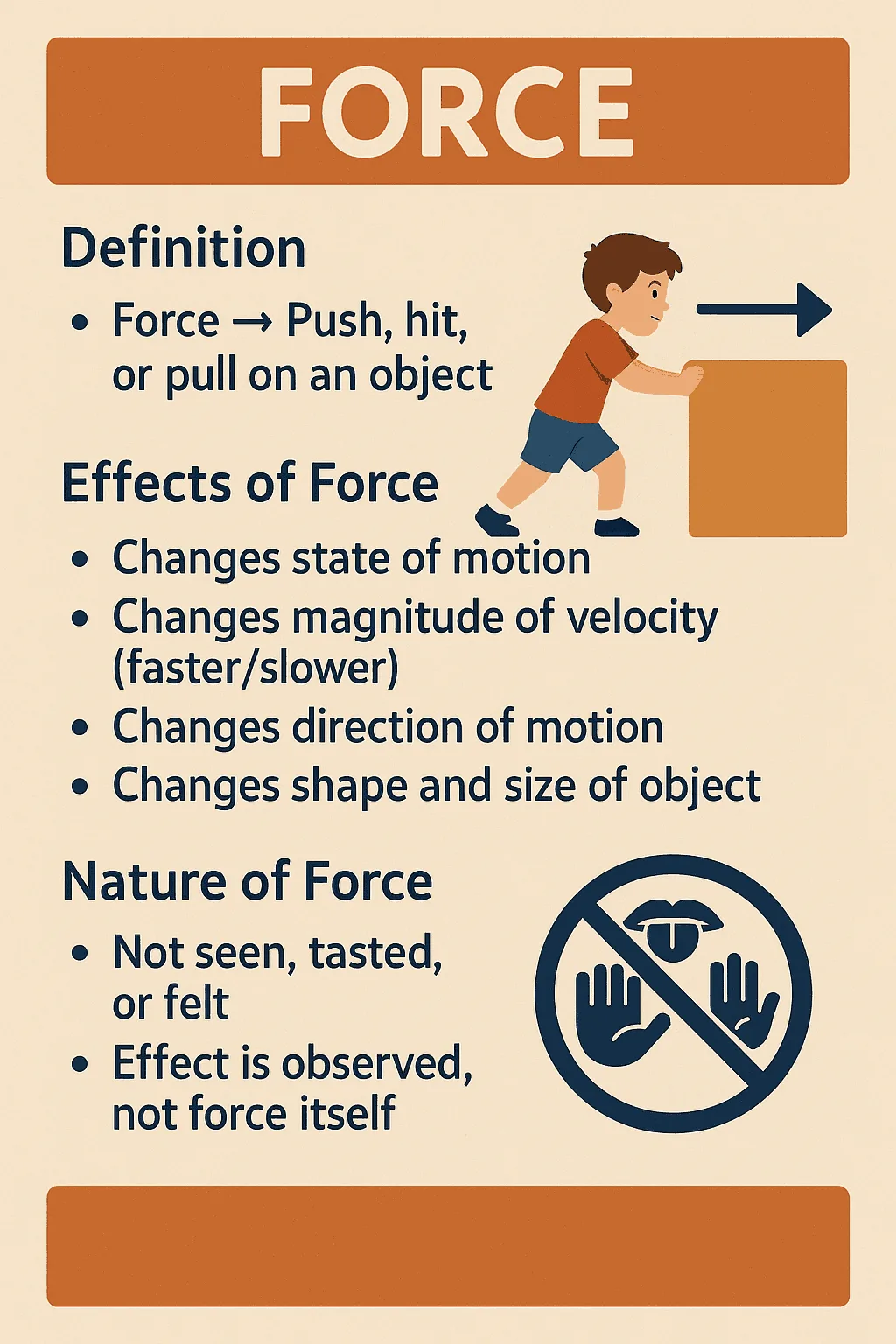
Effects of Force
- Changes state of motion
- Changes magnitude of velocity (faster/slower)
- Changes direction of motion
- Changes shape and size of object
Nature of Force
- Not seen, tasted, or felt
- Effect is observed, not force itself
BALANCED & UNBALANCED FORCES
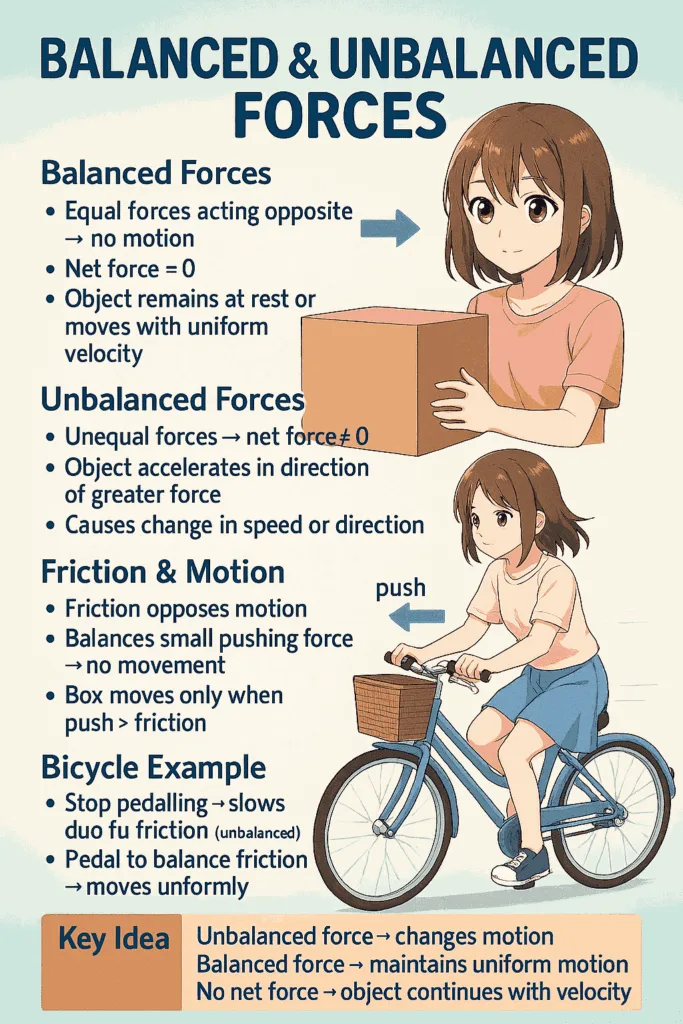
Balanced Forces
- Equal forces acting opposite → no motion
- Net force = 0
- Object remains at rest or moves with uniform velocity
Unbalanced Forces
- Unequal forces → net force ≠ 0
- Object accelerates in direction of greater force
- Causes change in speed or direction
Friction & Motion
- Friction opposes motion
- Balances small pushing force → no movement
- Box moves only when push > friction
Bicycle Example
- Stop pedalling → slows due to friction (unbalanced force)
- Pedal to balance friction → moves uniformly
- Unbalanced force → causes acceleration
Key Idea
- Unbalanced force → changes motion
- Balanced force → maintains uniform motion
- No net force → object continues with same velocity
FIRST LAW OF MOTION
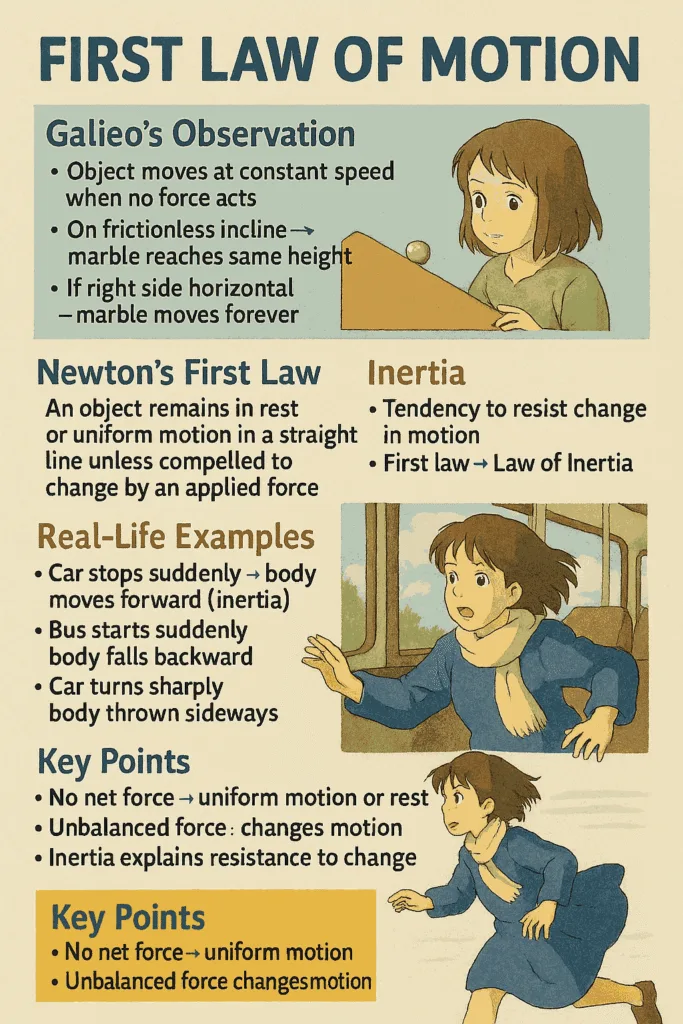
Galileo’s Observation
- Object moves at constant speed when no force acts
- On frictionless incline → marble reaches same height
- If right side horizontal → marble moves forever
Newton’s First Law
- An object remains in rest or uniform motion in a straight line unless compelled to change by an applied force
Inertia
- Tendency to resist change in motion
- First law → Law of Inertia
Real-Life Examples
- Car stops suddenly → body moves forward (inertia)
- Bus starts suddenly → body falls backward
- Car turns sharply → body thrown sideways
Key Points
- No net force → uniform motion or rest
- Unbalanced force → changes motion
- Inertia explains resistance to change
INERTIA AND MASS
Inertia
- Tendency to resist change in motion or rest
- Moving object → resists stopping
- Stationary object → resists moving
Mass & Inertia
- Heavier objects → more inertia
- Lighter objects → less inertia
- Mass measures inertia
Examples
- Empty box → easy to push
- Full box → harder to move
- Football → flies with kick
- Stone (same size) → barely moves, may injure foot
- One-rupee coin → less force needed than five-rupee coin
- Small cart → gains speed easily
- Train → negligible change with same force
Key Statement
- Inertia is the natural tendency of an object to resist a change in its state of motion or of rest.
- The mass of an object is a measure of its inertia.
SECOND LAW OF MOTION
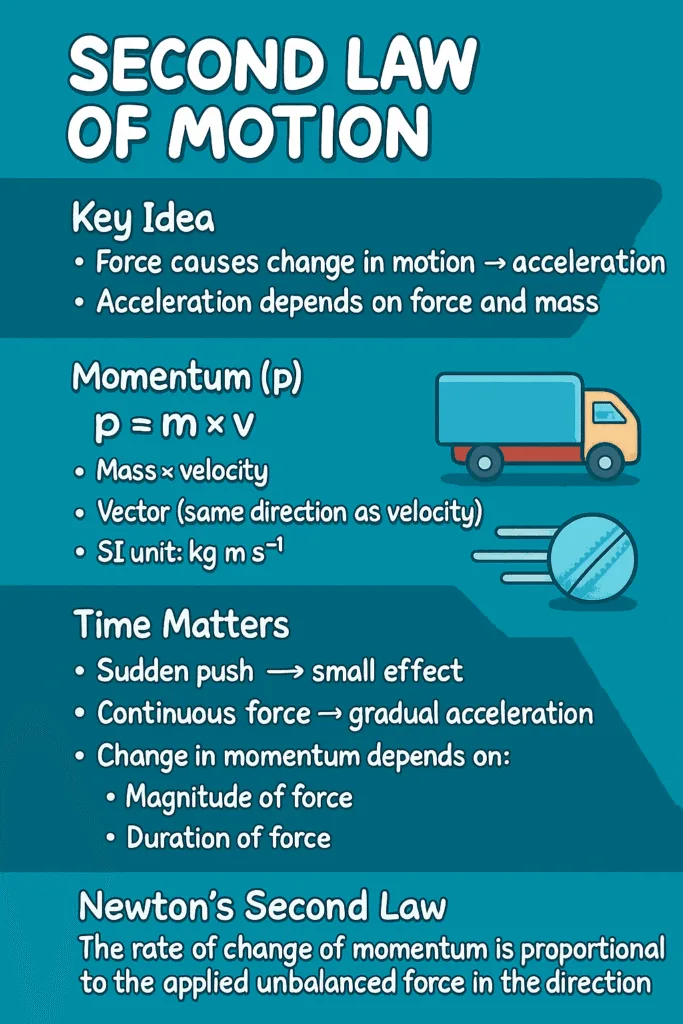
Key Idea
- Force causes change in motion → acceleration
- Acceleration depends on force and mass
Momentum (p)
- p = m × v
- Mass × velocity
- Vector (same direction as velocity)
- SI unit: kg m/s
Force & Momentum
- Unbalanced force → changes momentum
- Greater mass or speed → greater impact
- Bullet, truck, cricket ball → high momentum
Time Matters
- Sudden push → small effect
- Continuous force → gradual acceleration
- Change in momentum depends on:
• Magnitude of force
• Duration of force
Newton’s Second Law
- The rate of change of momentum is proportional to the applied unbalanced force in the direction of force.
Mathematical Formulation Of Second Law Of Motion
Momentum
- p1 = mu p2 = mv
- Change in momentum P2-P1 = mv – mu = m(v – u)
Rate of Change of Momentum
- F∝ m(v – u)/t
Force is rate of cahnge of momentum, hence
F ∝ m(v – u)/t
Acceleration
- a = (v – u)/t
Force Formula
- F = kma
- k = 1 (by SI unit definition)
- ∴ F = ma
Unit of Force
- kg m/s² = newton (N)
- 1 N = 1 kg × 1 m/s²
APPLICATIONS
- Fielder pulls hand back → increases time → reduces force
- Sand/cushion bed in high jump → increases time → reduces impact
- Karate blow → small time → large force → breaks ice
First Law from Second Law
- F = ma
- If F = 0 → a = 0 → v = u
- Object stays at rest or uniform motion
THIRD LAW OF MOTION
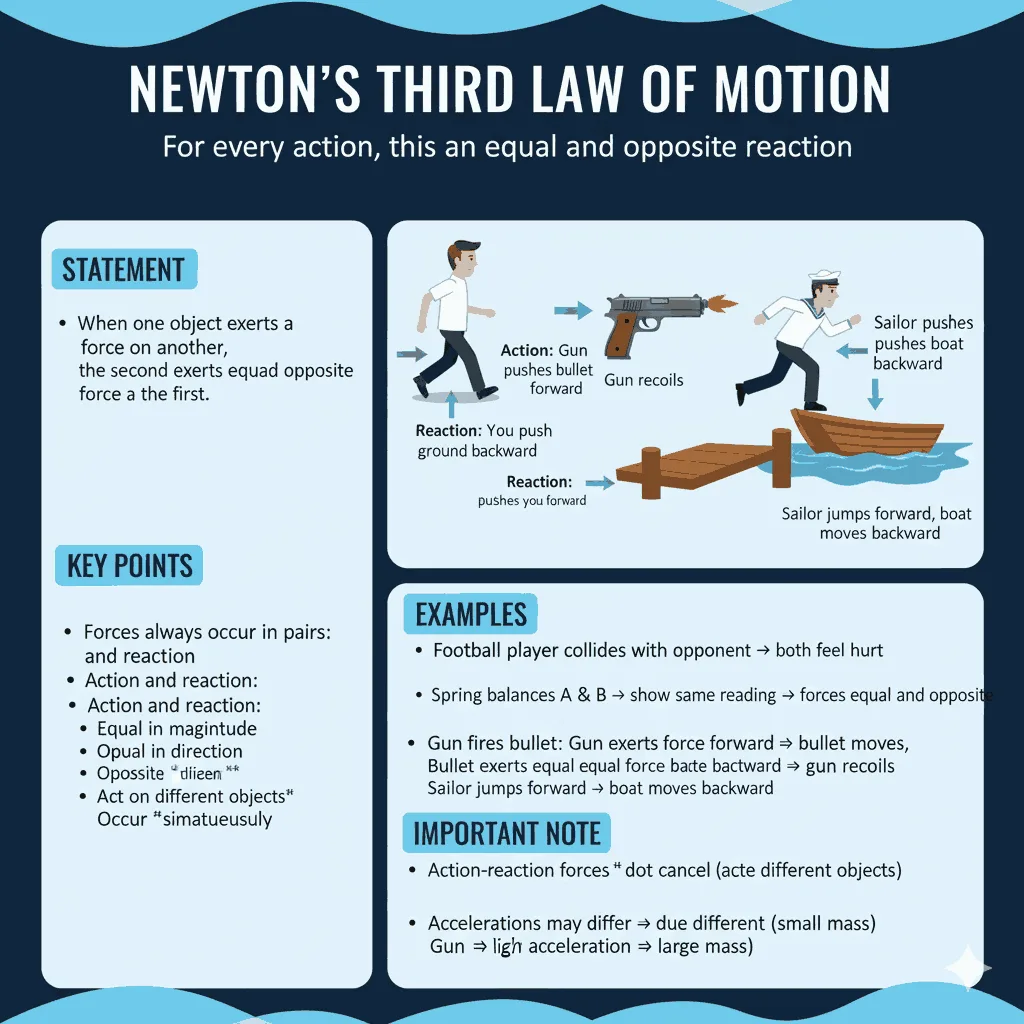
Statement
- When one object exerts a force on another,
the second exerts an equal and opposite force on the first
Key Points
- Forces always occur in pairs: action and reaction
- Action and reaction:
• Equal in magnitude
• Opposite in direction
• Act on different objects
• Occur simultaneously
Examples
- Football player collides with opponent → both feel hurt
- Spring balances A & B → show same reading → forces equal and opposite
- Walking:
• You push road backward (action)
• Road pushes you forward (reaction) - Gun fires bullet:
• Gun exerts force forward → bullet moves
• Bullet exerts equal force backward → gun recoils - Sailor jumps forward → boat moves backward
Important Note
- Action-reaction forces do not cancel (act on different objects)
- Accelerations may differ → due to different masses
• Bullet → high acceleration (small mass)
• Gun → low acceleration (large mass)
Conclusion : Short Notes Force And Laws Of Motion Class 9
Understanding Newton’s Laws of Motion and the concepts of force, inertia, and momentum is essential for mastering the fundamentals of physics. These principles explain how objects move, why they resist change, and how forces interact in everyday life — from walking and driving to sports and space travel.
The concise, mobile-friendly study notes provided above break down complex ideas into easy-to-scan summaries that are perfect for quick revision, exam prep, and last-minute learning.
Whether you’re a student preparing for board exams or a teacher looking for simplified classroom resources, these short, zero-explanation notes help you retain key physics concepts faster and longer.
This guide ensures you grasp the core of motion laws without information overload.
FAQs
Q1: What are the three laws of motion according to Newton?
A:
- First Law (Inertia): An object remains at rest or in uniform motion unless acted upon by an unbalanced force.
- Second Law (F = ma): The rate of change of momentum is proportional to the applied force; force equals mass times acceleration.
- Third Law (Action-Reaction): For every action, there is an equal and opposite reaction acting on different objects.
Q2: What is the relationship between mass and inertia?
A: Mass is a measure of an object’s inertia. Greater mass means greater resistance to change in motion. Heavier objects require more force to accelerate or stop.
Q3: How does Newton’s second law apply in real life?
A: Examples include a fielder pulling hands backward while catching a cricket ball (to reduce impact force) and athletes landing on cushioned beds in high jump (to increase time and reduce force).
Q4: Why are balanced and unbalanced forces important?
A: Balanced forces result in no change in motion (object stays at rest or moves uniformly). Unbalanced forces cause acceleration, making objects start, stop, or change direction.
Q5: How do action and reaction forces work?
A: When you push the ground backward while walking, the ground pushes you forward. The forces are equal and opposite but act on different bodies — you and the Earth.
Q6: Are these short study notes suitable for exam preparation?
A: Yes! These mobile-friendly, one-concept-per-screen notes are designed for fast revision, easy memorization, and long-term retention — ideal for CBSE, ICSE, NTSE, and competitive exams.
Q7: Why are these notes effective for learning physics concepts?
A: They use clear headings, minimal text, bullet points, and real-life examples to enhance understanding without overwhelming the learner. Perfect for visual and quick learners.
Q8: Can I use these notes for teaching or classroom use?
A: Absolutely. Teachers can use these structured, zero-explanation summaries as flashcards, handouts, or digital aids for interactive learning and concept reinforcement.
Q9: What is the SI unit of force and how is it derived?
A: The SI unit of force is the newton (N). It is derived from Newton’s second law:
1 N = 1 kg × 1 m/s² — the force required to accelerate 1 kg mass at 1 m/s².
Q10: How do these short notes help in understanding inertia and motion?
A: By focusing on definitions, effects, and examples in a distraction-free format, these notes make it easier to visualize, memorize, and recall key physics concepts quickly and accurately.