Welcome to ” Ch 7 Work Energy and Simple Machines Question Answer Class 9“.
Here’s a natural and simple version:
We have written the answers in a way that makes them easy to understand.
Here is what makes this guide different:
- NCERT Backed: Every single answer includes the exact page and equation number from your official NCERT textbook, so you can cross-verify instantly.
- Visual Learning: We have added clear, step-by-step diagrams and infographics to help you visualise trickier concepts like changing power, balanced levers, and energy graphs.
- Quick Revision: For a complete breakdown of the formulas and theories behind these questions, make sure to read our quick notes on this same chapter.
Let’s dive in!
Q1
State whether True or False.
(i) Work is said to be done when a force is applied, even if the object
does not move.
(ii) Lifting a bucket vertically upward results in positive work done
on the bucket.
(iii) The SI unit for both work and energy is joule (J).
(iv) A motionless stretched rubber band has kinetic energy.
(v) Energy can change from one form to another.
Answers:
(i) FALSE
➜ Work needs BOTH force AND displacement.
No movement = No work done.
(ii) TRUE
(iii) TRUE
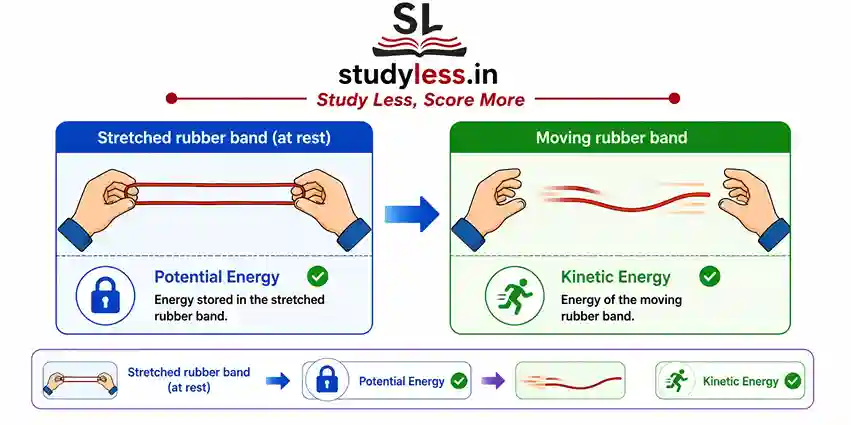
(iv) FALSE
➜ A stretched rubber band at rest has Potential Energy
(stored elastic energy), NOT kinetic energy.
Kinetic energy requires motion.
(v) TRUE
(i)Page 118, Section 7.1.1, “The work done on an object is also zero if there is no displacement…”
(ii) Page 118–119, Section 7.1.2, “When the displacement is in the same direction as the applied force, the work done… is said to be positive.”
(iii)Page 118, Section 7.1, “The SI unit of work done is joule…” and Page 120, Section 7.2, “The SI unit of energy is the same as the SI unit of work, the joule (J).”
| Quantity | SI Unit |
|---|---|
| Work | Joule (J) |
| Energy | Joule (J) |
| Power | Watt (W) |
(iv) Page 123–124, Section 7.4.2, “The stack of coins, ball and the arrow thus gain the kinetic energy they did not originally possess. This energy must have come from the stretched band…”
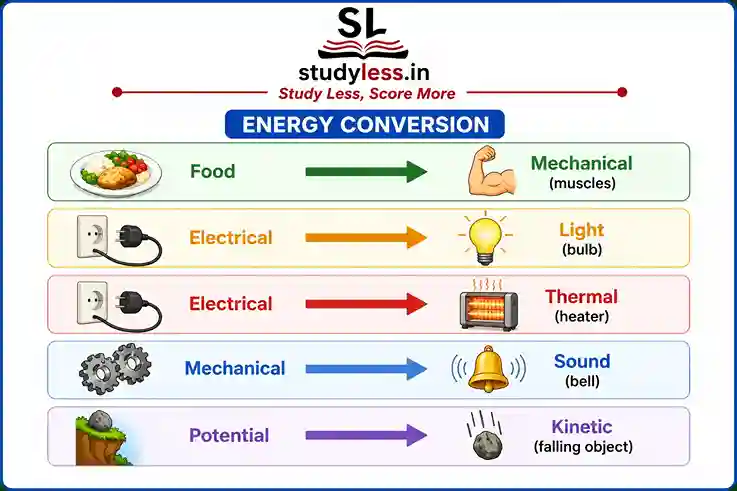
(v) Page 121, Section 7.3, “It is possible to change energy from one form to another. For example, electrical energy is converted into light energy in a bulb…”
Q2
Fill in the blanks.
(i) Work done = _ × _ (in the direction of force).
(ii) 1 joule of work is done when a force of ______newton displaces an object by 1 metre in the direction of the force.
(iii) The expression for kinetic energy of a body of mass m and velocity v is_______ .
(iv) The potential energy of an object of mass m at a small height h
from the Earth’s surface is_______ .
(v) Power is defined as the______________at which work is done.
Answers:
(i)Work done = Force × Displacement (in the direction of force)
(ii)1 joule of work is done when a force of 1 newton displaces an object by 1 metre in the direction of the force.
(iii) The expression for kinetic energy of a body of mass m and velocity v is ½mv²
(iv) The potential energy of an object of mass m at a small height h from the Earth’s surface is mgh
(v) Power is defined as the rate at which work is done.
| Blank | Answer | Formula |
|---|---|---|
| (i) | Force × Displacement | W = F × s |
| (ii) | 1 newton | 1 J = 1 N × 1 m |
| (iii) | ½mv² | K = ½mv² |
| (iv) | mgh | U = mgh |
| (v) | rate | P = W/t |
Source for all: Pages 117–129, Sections 7.1, 7.4.1, 7.4.2, 7.5
(i) Page 117, Eq. 7.2, “W = F × s”
(ii) Page 118, “1 joule of work is done on an object when a constant force of 1 newton is applied…”
(iii) Page 122, Eq. 7.6, “K = ½mv²”
(iv) Page 125, Eq. 7.8, “U = mgh”
(v) Page 129, Section 7.5, “Power is defined as the rate at which work is done.”
Q3
When a ball thrown upwards reaches its highest point, tick which of
the following statement(s) are correct?
(i) The force acting on the ball is zero.
(ii) The acceleration of the ball is zero.
(iii) Its kinetic energy is zero.
(iv) Its potential energy is maximum.
Answers:
Analysis at the Highest Point:
| Statement | True/False | Reason |
|---|---|---|
| (i) Force acting on the ball is zero | FALSE | Gravity (mg) always acts downward |
| (ii) Acceleration of the ball is zero | FALSE | g = 10 m/s² downward always acts |
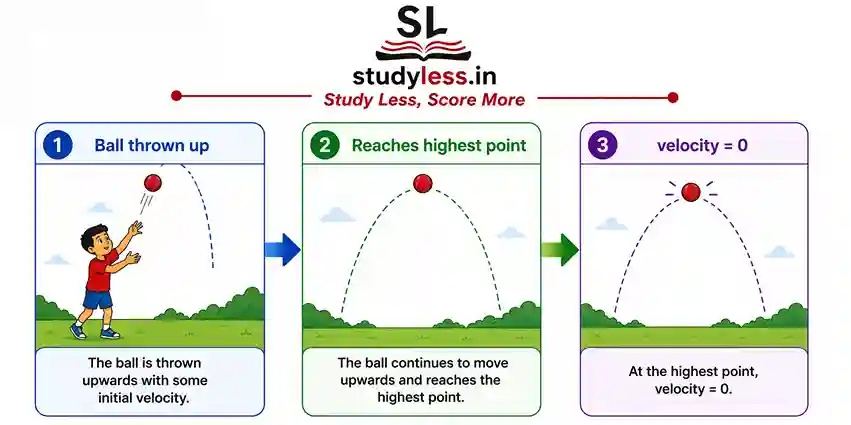
| (iii) Kinetic energy is zero | TRUE | KE = ½mv²; v = 0 at top, so KE = 0 |
| (iv) Potential energy is maximum | TRUE | Height is maximum, so U = mgh is maximum |
Correct answers: (iii) and (iv)
Pages 121–125, Sections 7.4.1 and 7.4.2
Page 122, “The kinetic energy has no direction. When… velocity decreases, its kinetic energy will also decrease.” and Page 125, “the greater the height of the ball above the Earth’s surface, the greater is its potential energy.”
Q4
For each of the following situations, identify the energy transformation
that takes place:
(i) a truck moving uphill,
(ii) unwinding of a watch
spring,
(iii) photosynthesis in green leaves,
(iv) water flowing from
a dam,
(v) burning of a matchstick,
(vi) explosion of a firecracker,
(vii) speaking into a microphone,
(viii) a glowing electric bulb, and
(ix) a solar panel.
Answers:
Energy from one form to another…”
| Situation | Energy Transformation |
|---|---|
| (i) Truck moving uphill | Chemical (fuel) → Kinetic + Potential |
| (ii) Unwinding of a watch spring | Elastic Potential → Mechanical (Kinetic) |
| (iii) Photosynthesis in green leaves | Light → Chemical |
| (iv) Water flowing from a dam | Potential → Kinetic → Electrical |
| (v) Burning of a matchstick | Chemical → Thermal + Light |
| (vi) Explosion of a firecracker | Chemical → Thermal + Light + Sound |
| (vii) Speaking into a microphone | Sound → Electrical |
| (viii) A glowing electric bulb | Electrical → Light + Thermal |
| (ix) A solar panel | Light → Electrical |
Imp – Rule: Energy changes form but is never created or destroyed.
Page 121, Section 7.3, “It is possible to change energy from one form to another…”
Q5
A student is slowly lifted straight up in an elevator from the ground
level to the top floor of a building. Later, the same student climbs the
staircase, all the way to the top. Given that the height of the building is
h = 72.5 m, acceleration due to gravity is g = 10 m s-2, and student’s mass
is m = 50 kg.
(i) Find the gain in the potential energy if the student is lifted straight up
up to the top.
(ii) Find the gain in the potential energy when the student climbs the
stairs to the same top.
(iii) What do you conclude about the dependence of the potential
energy on the path taken?
Answers:
(i) Potential energy gained in the elevator:
U = mgh = 50 kg × 10 m/s² × 72.5 m = 36,250 J
(ii) Potential energy gained climbing stairs:
U = mgh = 50 kg × 10 m/s² × 72.5 m = 36,250 J
(iii) Conclusion:
Potential energy does NOT depend on the path taken. It depends only on the height gained (h), mass (m), and gravity (g).
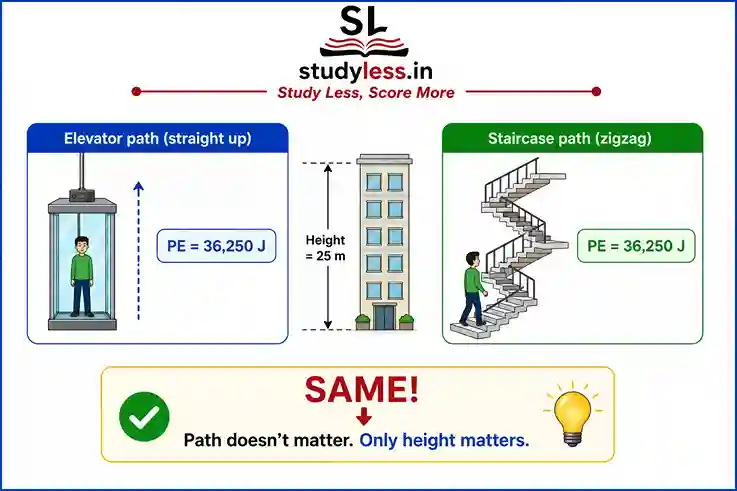
Page 125, Section 7.4.2 (Gravitational Potential Energy), Eq. 7.8, “U = mgh”
Q6
A crane lifts a mass m to the 10th floor of a building in a certain time. It then raises the same mass to the 20th floor of the same building in double the time. How much more energy and power are required? Assume that the height of all floors is equal.
Answers:
Let the height of each floor = H
| 10th Floor | 20th Floor | |
|---|---|---|
| Height | 10H | 20H |
| Energy (= mgh) | 10mgH | 20mgH |
| Time | t | 2t |
| Power (= Energy/Time) | 10mgH/t | 20mgH/2t = 10mgH/t |
Energy required for 20th floor = 2 × energy for 10th floor (double the energy)
Power required = SAME (the extra height is exactly balanced by double the time)
Simple conclusion:
- More energy needed: 2 times more
- More power needed: No change (same power)
Pages 125, 129, Sections 7.4.2 and 7.5, Eq. 7.8 and 7.11
Q7
Which factors determine the energy required to raise a flag from the ground to the top of a tall flagpole using a pulley? Does raising the flag slowly or quickly change the amount of work done? If the speed at which the flag is raised is doubled, how does the power requirement change? Explain your answers.
Answers:
Factors that determine energy required:
| Factor | Effect |
|---|---|
| Mass of flag (m) | More mass = More energy |
| Height of flagpole (h) | More height = More energy |
| Gravity (g) | Fixed at ~10 m/s² on Earth |
Energy = mgh (speed does NOT affect energy required)
Does raising slowly or quickly change the work done?
No. The work done (energy) is the same regardless of speed. W = mgh in both cases.
If speed is doubled, how does power change?
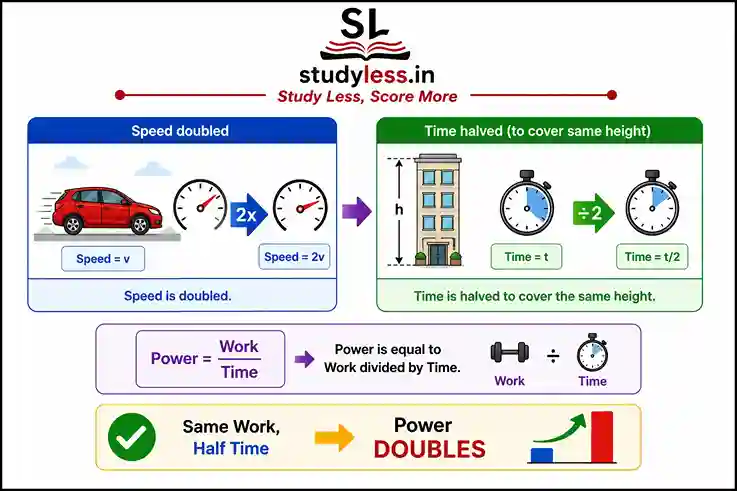
Power doubles when speed is doubled.
Page 125, Eq. 7.8 (U = mgh) and Page 129, Section 7.5 (P = W/t)
Q8
A man of mass 60 kg rides a scooter of mass 100 kg. He accelerates the scooter to a velocity v. The next day, his son with a mass of 40 kg joins him as a passenger. If the scooter reaches the same speed on both days in the same time interval, what is the ratio of the fuel of the tank used on the two days? Assume that the energy transfer to the scooter happens entirely due to fuel, and no other losses occur due to air resistance and friction.
Answers:
Since fuel energy converts entirely to kinetic energy:
Day 1: Total mass = 60 + 100 = 160 kg
Day 2: Total mass = 60 + 40 + 100 = 200 kg
The family uses more fuel on Day 2 because a greater total mass needs more energy to reach the same speed.
Page 122, Eq. 7.6, “K = ½mv²”
Q9
On a seesaw with sliding seats, a child is sitting on one side and an adult on the other side. The adult weighs twice that of the child. The seesaw however is balanced. Draw a figure which depicts this situation showing the distances from the fulcrum where the child and the adult are seated.
Answers:
Let child’s weight = W, Adult’s weight = 2W
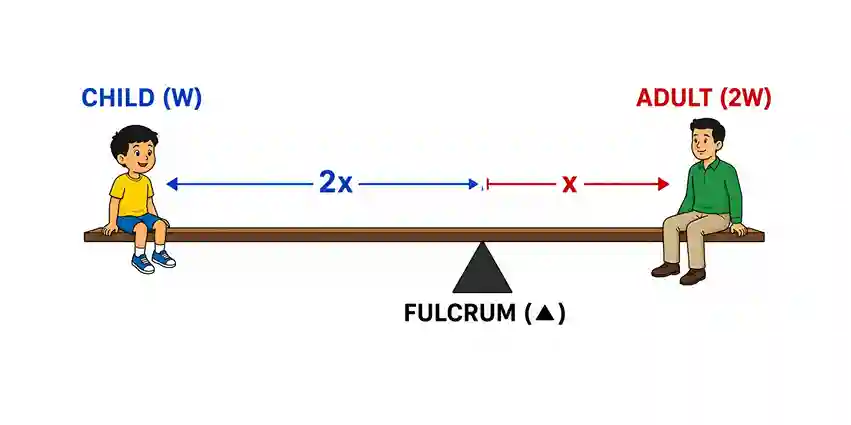
If the adult sits 1 m from the fulcrum → the child sits 2 m from the fulcrum.
Page 134, Section 7.6.3, Eq. 7.15, “effort × effort arm = load × load arm”
Q10
A ball of mass 2 kg is thrown up with a velocity of 20 m s–1.
(i) Identify the sign of the work done by gravity on the ball during its
upward motion and its downward motion.
(ii) If the ball reaches a height of 19.4 m, how much work was done by
air resistance (assume g = 10 m s–2).
Answers:
(i) Sign of work done by gravity:
| Phase | Direction of gravity | Direction of motion | Work done by gravity |
|---|---|---|---|
| Upward | Downward ↓ | Upward ↑ | Negative |
| Downward | Downward ↓ | Downward ↓ | Positive |
(ii) Work done by air resistance (ball reaches 19.4 m, g = 10 m/s²):
KE at top = 0 J (ball momentarily at rest)
Using Work-Energy Theorem:
Work done by all forces = Change in KE
Air resistance did −12 J of work (it opposes motion, so negative).
Pages 118–119, Section 7.1.2; Page 122, Eq. 7.6; Page 125, Eq. 7.8
Q11
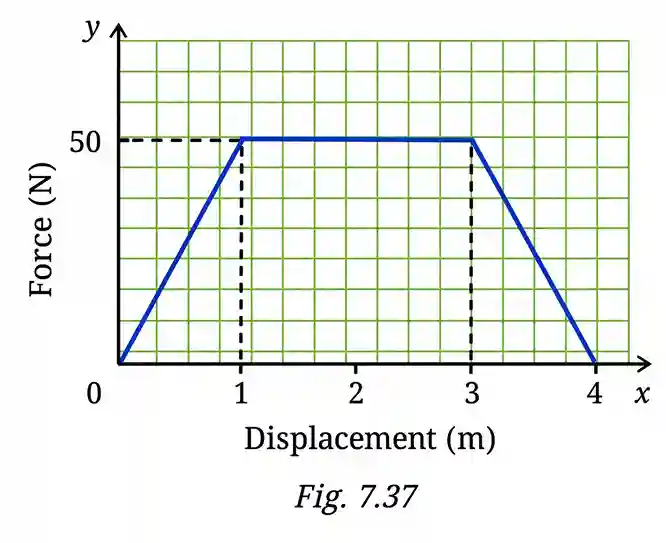
A 10.0 kg block is moving on horizontal floor with negligible friction. As shown in the Fig. 7.37, a variable force is applied on the block in its direction of motion from its position at 0 m till 4 m. If the block had a kinetic energy of 180 J when it was at 0 m, find the block’s speed
(i) at 0 m, and
(ii) at 4 m.
Does the block have negative acceleration in any portion of its motion?
Answers:
(i) Speed at 0 m:
(ii) Speed at 4 m:
From Fig. 7.37 (force-displacement graph), the area under the graph from 0 to 4 m:
- From 0 to 2 m: triangle with base 2, height 50 N → Area = ½ × 2 × 50 = 50 J
- From 2 to 3 m: triangle above zero → +25 J
- From 3 to 4 m: triangle below zero → −25 J
Total work done by force = 50 J
Does block have negative acceleration?
Yes. Between 3 m and 4 m, the force is negative (from graph), meaning the force opposes motion. This causes negative acceleration (deceleration) in that portion.
Page 122, Eq. 7.6; Page 118, “work done can still be calculated by finding the area under the force-displacement graph”
Q12
The gravitational attraction on the surface of the Moon (lunar surface) is about 1/6th of that on the surface of the Earth. An astronaut can throw a ball up to a height of 8 m from the surface of the Earth. How far up will the ball thrown with the same upward velocity travel from the surface of the Moon?
Answers:
Using conservation of energy:
KE at bottom = PE at top
therefore, h = v²/2g
Since the initial velocity (v) is the same on both Earth and Moon:
The ball goes 6 times higher on the Moon because gravity is 6 times weaker.
Page 125, Section 7.4.2 and conservation of mechanical energy (Page 126–127)
Q13
A 1000 kg car is moving along a road at a constant speed. Suddenly, the driver notices some obstruction ahead and applies the brakes to come to a complete stop. The graphical representation of motion of the car starting from the instant the driver spots the traffic ahead is shown in Fig. 7.38.
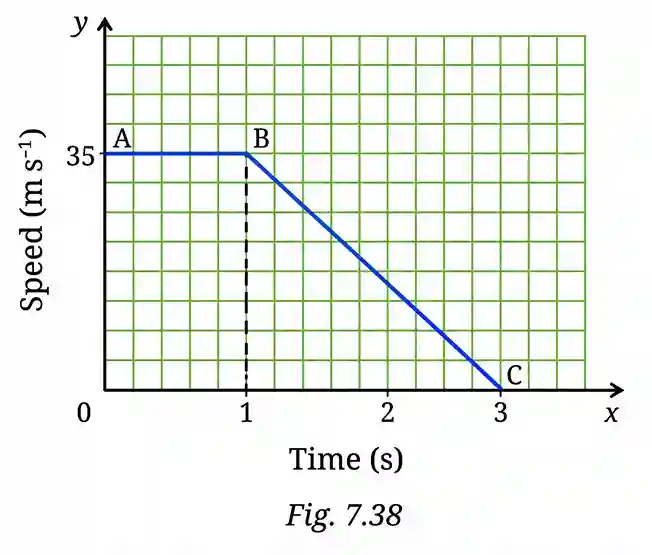
(i) Describe how the car moves between positions A and B.
(ii) Calculate the kinetic energy of the car at A.
(iii) State the work done by the brakes in bringing the car to
a halt between B and C.
(iv) What does the kinetic energy of the car transform into?
Answers:
(i) How car moves between A and B:
The car moves at constant speed (35 m/s). No acceleration. The driver sees the obstruction but hasn’t braked yet (reaction time period).
(ii) Kinetic energy at A:
(iii) Work done by brakes (B to C):
At B:
KE = 612,500 J;
At C:
KE = 0 J
Work done by brakes = Change in KE = 0 − 612,500 = −612,500 J
Brakes do negative work of 612,500 J (they oppose motion).
(iv) What does kinetic energy transform into?
KE transforms into thermal energy (heat) due to friction between brake pads and wheels, and between tyres and the road. Some may also convert to sound energy.
Pages 121–122, Sections 7.2 and 7.4.1; Page 129, Section 7.5
From Fig. 7.38: Speed at A and B = 35 m/s; speed at C = 0 m/s
Q14
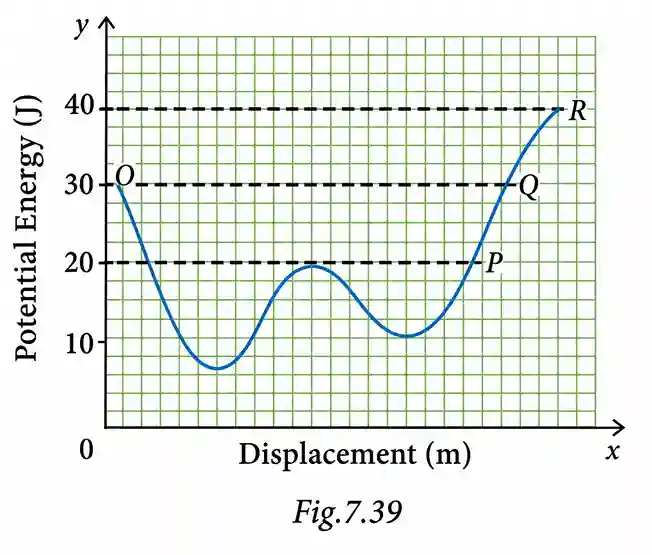
The potential energy-displacement graph of a 0.5 kg ball moving along a frictionless track is shown in Fig. 7.39. At O, the velocity of the ball is 0 m s–1 and potential energy is 30 J. Calculate the velocity of the ball at P, Q and R.
Answers:
Since the track is frictionless:
Total mechanical energy = constant = 30 J (at O, all PE)
From Fig. 7.39:
- At P: PE = 20 J
- At Q: PE = 30 J
- At R: PE = 40 J
At P:
At Q:
At R:
Since KE cannot be negative, the ball cannot reach point R. It will turn back before reaching R (it doesn’t have enough energy).
| Point | PE (J) | KE (J) | Speed (m/s) |
|---|---|---|---|
| O | 30 | 0 | 0 |
| P | 20 | 10 | ~6.32 |
| Q | 30 | 0 | 0 |
| R | 40 | — | Cannot reach |
Page 126–127, Section 7.4.3, Conservation of mechanical energy
Q15
A coconut of mass 1.5 kg falls from the top of a coconut tree onto the wet sand on a beach. The height of the tree is 10 m. On impact, the coconut comes to rest by making a depression in the sand.
(i) Calculate the velocity of the coconut just before it hits the sand.
(ii) Assume that the average resistive force of sand is 3000 N and all of
the coconut’s energy is used to create the depression in the sand.
Calculate the depth of the depression the coconut makes in the
sand. Assume g = 10 m s–2.
Answers:
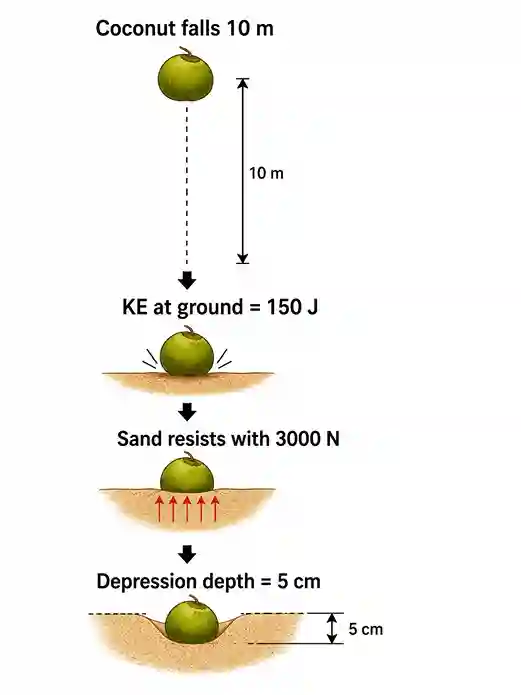
(i) Velocity just before hitting sand:
Using conservation of mechanical energy:
PE at top = KE at bottom:
(ii) Depth of depression in sand:
KE just before impact
This energy is used against the resistive force of sand:
Work done by sand = Force × depth
Source: Pages 125–128, Sections 7.4.2 and 7.4.3, Eqs. 7.6 and 7.8
Bonus: Master Summary Table — All Key Formulas from Chapter 7
| Concept | Formula | Unit | Page |
|---|---|---|---|
| Work done | W = F × s | Joule (J) | 117 |
| Kinetic Energy | K = ½mv² | Joule (J) | 122 |
| Potential Energy | U = mgh | Joule (J) | 125 |
| Mechanical Energy | ME = KE + PE | Joule (J) | 126 |
| Power | P = W/t | Watt (W) | 129 |
| Mechanical Advantage | MA = Load/Effort | No unit | 130 |
| Inclined Plane MA | MA = L/h | No unit | 132 |
| Lever balance | F₁×d₁ = F₂×d₂ | — | 133 |
Study Tip:
The single most important idea in this chapter is the Work-Energy Theorem — work done on an object equals the change in its energy. Every question, directly or indirectly, comes back to this one idea.
FAQs: Ch 7 Work Energy and Simple Machines Question Answer Class 9
Please keep your class 9 NCERT textbook, Exploration. You will need it to refer again and again to the below FAQs.
Link to textbooks – NCERT Books class 9
What is the difference between work, energy, and power in science — and why does it matter for Grade 9 exams?
Work and energy share the same unit (Joule), but they are not the same thing. Work is the process of transferring energy. Energy is what an object possesses. Power tells you how fast that transfer happens.
Real-life example from the chapter (Page 129): Carrying your school bag up stairs in 1 minute vs. 5 minutes — same work is done both times, but running up requires MORE power because less time is taken.
Why this matters for exams: Questions frequently test whether students confuse these three. The Work-Energy Theorem (W = ΔE) ties all three together elegantly.
These three terms are related but measure different things:
| Term | Scientific Definition | Formula | Unit |
|---|---|---|---|
| Work | Force × Displacement in direction of force | W = F × s | Joule (J) |
| Energy | Capacity to do work | KE = ½mv² / PE = mgh | Joule (J) |
| Power | Rate at which work is done | P = W/t | Watt (W) |
When is work done equal to zero? Give three real-life examples with a scientific explanation.
Work is zero in exactly three situations, all following from W = F × s:
| Situation | Why Work = Zero | Real Example |
|---|---|---|
| Force = 0 | Nothing to multiply displacement with | Object floating in space |
| Displacement = 0 | Object doesn’t move | Pushing a rigid wall |
| Force ⊥ Displacement | No component of force in direction of motion | Carrying a box while walking horizontally |
The wall-pushing paradox (Page 118, Section 7.1.1):
You push a wall hard. You feel tired. Yet science says you did zero work on the wall.
Why? Your muscles expand and contract repeatedly, using your body’s internal energy, which causes fatigue. But the wall didn’t move, so no scientific work was done ON the wall.
The carrying-a-box paradox (Page 118, Section 7.1.1):
A girl carries a box horizontally. She applies force upward (to hold the box). The box moves horizontally. These two directions are perpendicular (90°). Result: zero work done by her holding force on the box.
What is the conservation of mechanical energy, and how does a simple pendulum demonstrate it perfectly?
Conservation of Mechanical Energy states:
The total mechanical energy (KE + PE) of an object remains constant when no external forces (like friction) act on it.
The Pendulum — Nature’s Perfect Demonstration
(Page 127, Section 7.4.3):
Key insight: At every single point of the swing, KE + PE = constant = mgh
Why does a real pendulum eventually stop? Friction at the support and air resistance steal energy away as heat and sound. This does NOT violate conservation of energy — it just means energy converts to other forms.
The slide problem (Example 7.8, Page 128): Using this principle, the speed of a child at the bottom of any slide of height h is:
v = √(2gh)
Three remarkable facts follow:
- The mass of the child doesn’t matter.
- The shape of the slide doesn’t matter.
- Only the HEIGHT matters.
This is why this principle is so powerful — it bypasses all the complicated intermediate steps of motion.
How do simple machines make work easier without reducing the total work done? Explain with a pulley, an inclined plane, and a lever.
The Golden Rule of Simple Machines (Page 135):
Machines do NOT create or reduce energy. They only redistribute force and distance. If force decreases, distance must increase — so total work stays the same.
Comparison of Three Simple Machines:
| Machine | What it Changes | Mechanical Advantage | Real Examples |
|---|---|---|---|
| Fixed Pulley | Direction of force only | = 1 (no force reduction) | Flag hoisting, wells |
| Inclined Plane | Reduces force needed | = L/h (always > 1) | Ramps, mountain roads, wheelchair ramps |
| Lever | Reduces force OR increases distance | = Effort arm / Load arm | Seesaw, scissors, bottle opener |
The Inclined Plane insight (Page 132, Eq. 7.13):
MA = L/h
A ramp that is 50 cm long, lifting something 30 cm high has MA = 50/30 = 1.67. You need only 60% of the force you’d need to lift directly.
The Lever insight (Page 134, Eq. 7.16):
MA = Effort arm / Load arm
Sit farther from the fulcrum on a seesaw → you need less force to lift someone heavier sitting closer.
Three Classes of Levers at a glance:
| Class | What’s in the Middle | Examples |
|---|---|---|
| Class I | Fulcrum | Scissors, seesaw, crowbar |
| Class II | Load | Bottle opener, wheelbarrow |
| Class III | Effort | Tweezers, broom, hammer |
Why perpetual motion machines are impossible (Page 135): Real machines always lose energy to friction as heat. You can never get more work out than you put in. This is non-negotiable physics.
What is the Work-Energy Theorem, and how can it solve problems that Newton’s Laws cannot solve easily?
The Work-Energy Theorem (Page 120, Eq. 7.3):
Work done on an object = Change in its energy
W = ΔKE = ½mv² − ½mu²
Why this theorem is a game-changer:
Newton’s Laws require you to know forces at every instant of motion. The Work-Energy Theorem only needs the starting point and ending point — it skips everything in between.
Proof that KE = ½mv² (Page 122, Section 7.4.1):
Starting from v² = u² + 2as and W = F × s = ma × s:
W = ma × (v² − u²)/2a = ½m(v² − u²)
When u = 0: W = ½mv² = KE gained
Three real problems this theorem solves instantly:
Problem 1 — Aircraft landing (Example 7.6, Page 123):
A jet of 15,000 kg stopped by a wire over 100 m. Find approach speed. → Wire’s work = Change in KE → Solved in 3 lines.
Problem 2 — Escape ramp (Example 7.9, Page 128):
Truck with failed brakes, find the minimum ramp length. → KE of truck = Work by sand + PE gained → 20 m answer.
Problem 3 — Velocity doubling (Example 7.4, Page 122):
If velocity doubles, KE becomes 4 times (because KE ∝ v²).
| Velocity change | KE change |
|---|---|
| ×2 | ×4 |
| ×3 | ×9 |
| ×½ | ×¼ |

![Class 9 New NCERT Social Science[SST] Textbook 2026-2027](https://studyless.in/wp-content/uploads/2026/06/Class-9-New-NCERT-Social-ScienceSST-Textbook-2026-2027-2.webp)