If you are a student, parent, or teacher preparing for the upcoming academic session, you may have heard about the big changes in the Indian school curriculum.
Under the National Education Policy (NEP) 2020 and the National Curriculum Framework (NCF) 2023, NCERT is introducing new textbooks.
These books aim to move beyond rote learning and focus more on understanding and critical thinking.
But an important question many people are asking is: When will the new NCERT Class 9 books be available?
This question has become especially relevant as schools, teachers, and students prepare for the next academic session and want to know when the updated textbooks will reach classrooms.
Here is everything you need to know about the release dates, the new subjects, and what these changes mean for you.
The Official Release Timeline
According to the Ministry of Education and recent NCERT drafts, the rollout of new textbooks is happening in a phased manner to ensure a smooth transition for the entire school system.
- Release Date: The brand-new textbooks for Class 9 are scheduled to be available by March 2026.
- Effective Session: These books will be officially implemented for the 2026-27 academic session, which typically begins in April.
- Printing Boost: To avoid the common problem of book shortages, the government has tripled printing capacity from 5 crore to 15 crore textbooks annually starting in 2026.
| Academic Session | Grades Transitioning | Status |
| 2024-2025 | 1, 2, 3, 6 | Completed |
| 2025-2026 | 4, 5, 7, 8 | Ongoing |
| 2026-2027 | 9, 11 | Scheduled for March 2026 |
| 2027-2028 | 10, 12 | Final Phase |
Major Changes in Class 9 Subjects
The 2026-27 session isn’t just a minor update; it’s a “fundamental restructure” of the syllabus. Using old books from seniors is officially discouraged, as the content will no longer match the new curriculum.
1. English: The Arrival of ‘Kaveri.’
The long-standing Beehive and Moments books are being retired. They will be replaced by a single, integrated textbook titled Kaveri.
- Focus: Functional language proficiency and creative expression.
- Structure: 8 Prose and 8 Poetry chapters, focusing on interpretation rather than just “finding the answer”.
2. Mathematics: ‘Ganita Prakash.’
The new Math textbook, Ganita Prakash, integrates modern algebra with ancient Indian mathematical traditions, such as the Baudhayana’s Sulbasutras.
- Advanced Topics: Concepts like Arithmetic Progression (AP) and Geometric Progression (GP), previously reserved for Classes 10 and 11, are being introduced in Class 9 to build a stronger foundation early on.
3. Science: ‘Curiosity.’
The Science curriculum is being redesigned under the title Curiosity to emphasize observation and experimentation.
- Reproduction: This chapter has been moved from Class 10 to Class 9.
- Modern Biology: Sections on Cell Structure and Tissues have been updated with the latest advancements in cell biology.
Innovative Assessment: Open-Book Exams
One of the most talked-about changes for the 2026-27 session is the introduction of Open-Book Assessments (OBA) for Class 9.
- How it works: In core subjects like Math, Science, and Social Science, students will be allowed to refer to their textbooks and notes during internal school exams.
- The Goal: To test how students apply information in real-world contexts rather than how well they can memorize facts.
Digital Integration: The DIKSHA Platform
The new 2026 textbooks will be “Smart Books.” Each book will feature QR codes that students can scan using the DIKSHA app to access interactive digital content, virtual labs, and video explanations.
Summary for Parents and Students
If you are entering Class 9 in 2026, do not buy second-hand books from the current 2025 batch. The transition to the NCF 2023 framework means the 20-year-old curriculum is being completely replaced to better prepare students for the 21st-century world.
Proofs of the New NCERT Class 9 Textbook Rollout
The transition to new textbooks for the 2026-27 academic session is supported by official government directives, massive logistical preparations, and released curriculum drafts. The following points serve as evidence for this institutional shift:
- Official Ministerial Announcement: Union Education Minister Dharmendra Pradhan has publicly confirmed that new textbooks aligned with the updated curriculum for Classes 9–12 will be available for the 2026-27 session.
- Tripled Printing Capacity: To meet the demand for these new materials, NCERT is increasing its annual printing capacity from 5 crore to 15 crore textbooks starting in 2026.
- Draft Syllabus Releases: NCERT has already released draft syllabus documents for Grade 9 subjects, including Languages, Mathematics, and Science, which are explicitly designed for the “Secondary Stage Phase I” starting in 2026.
- Digital Integration: New textbooks like Kaveri (English) already feature embedded QR codes intended for use with the DIKSHA platform, a key component of the “One Nation, One Digital Platform” initiative for the 2026 session.
- Obsolescence of Old Materials: Official notifications have advised students entering Class 9 in 2026 against purchasing second-hand books, as the previous resources based on the 2005 framework will be considered obsolete.
Expert Perspectives on the New Curriculum
Academicians and educational authorities have highlighted that these changes represent a move toward competency-based, real-world learning.
| Person / Authority | Role / Organization | Key Statement regarding New Books/Curriculum |
| Dharmendra Pradhan | Union Education Minister | Stated that the volume of printing will lead to reduced prices for some classes and that books for 9–12 will be ready by the 2026-27 session. |
| NCERT Draft (2023) | National Curriculum Framework | Specifies a move away from rote learning toward comprehension, communication, and critical engagement. |
| CBSE Governing Body | Decision-making Authority | Approved the introduction of Open-Book Assessments for Class 9 in 2026-27 to test interpretation rather than factual recall. |
| Agrawal Group (Educart) | Educational Analysts | Noted that while Beehive trains students to answer, the new book Kaveri, will train them to interpret and express. |
| Ministry of Education | Central Government | Emphasized that the new textbooks will address previous demand-supply gaps through increased quality and affordability. |
Frequently Asked Questions: When Will the New NCERT Class 9 Books Be Available?
General Transition & Availability
- When will the new NCERT books for Class 9 be available? The brand-new textbooks for Class 9 are scheduled to be released by March 2026.
- Is this change mandatory for all schools? Yes, the revised syllabus applies to all CBSE-affiliated schools and state boards, such as the UP Board, that follow the NCERT curriculum.
- Can students use second-hand books from their seniors?No. Students entering Class 9 in 2026 are strongly advised against using old books. The changes are fundamental restructures—not minor edits—making previous resources based on the 2005 framework obsolete.
- Will there be enough books available to prevent shortages? Yes. The Union Education Ministry has tripled printing capacity from 5 crore to 15 crore textbooks annually starting in 2026 to address supply concerns.
Subject-Specific Changes
- What is the new English textbook for Class 9? The books Beehive and Moments are being replaced by a single integrated textbook titled Kaveri.
- What has changed in the Mathematics syllabus? The new book, Ganita Prakash, now includes advanced topics like Arithmetic Progression ($AP$) and Geometric Progression ($GP$) which were previously taught in higher grades.
- How is the Science curriculum different? The new Science book, titled Curiosity, shifts from rote memorization to observation and experimentation. Notably, the chapter on Reproduction has been moved from Class 10 to Class 9.
- What is the “Social Science” restructure? The new curriculum moves away from a heavy focus on European Revolutions to Indian Civilizations (up to 1700 CE) and introduces practical units on Financial Literacy, Startups, and Budgeting.
Assessment & Learning
- What are Open-Book Assessments (OBA)? Starting in 2026-27, Class 9 internal exams for core subjects (Math, Science, Social Science, Language) will allow students to refer to textbooks and notes. The goal is to test the application and analysis rather than the memory.
- How do “Smart Books” and QR codes work? Every new textbook features embedded QR codes. By scanning these with the DIKSHA app, students can access digital content, interactive lessons, and virtual labs 24/7.
- What is the role of the teacher in this new system? Teachers will shift from being “lecturers” to facilitators and mentors. The focus is on guiding inquiry-based learning and competency-based mastery.
Financial Impact
- Will the new books be more expensive? Actually, prices for some classes are expected to decrease. The Education Ministry has stated that the high volume of printing (15 crore books) will allow for better affordability without increasing the financial burden on parents.
Update on 2nd April 2026
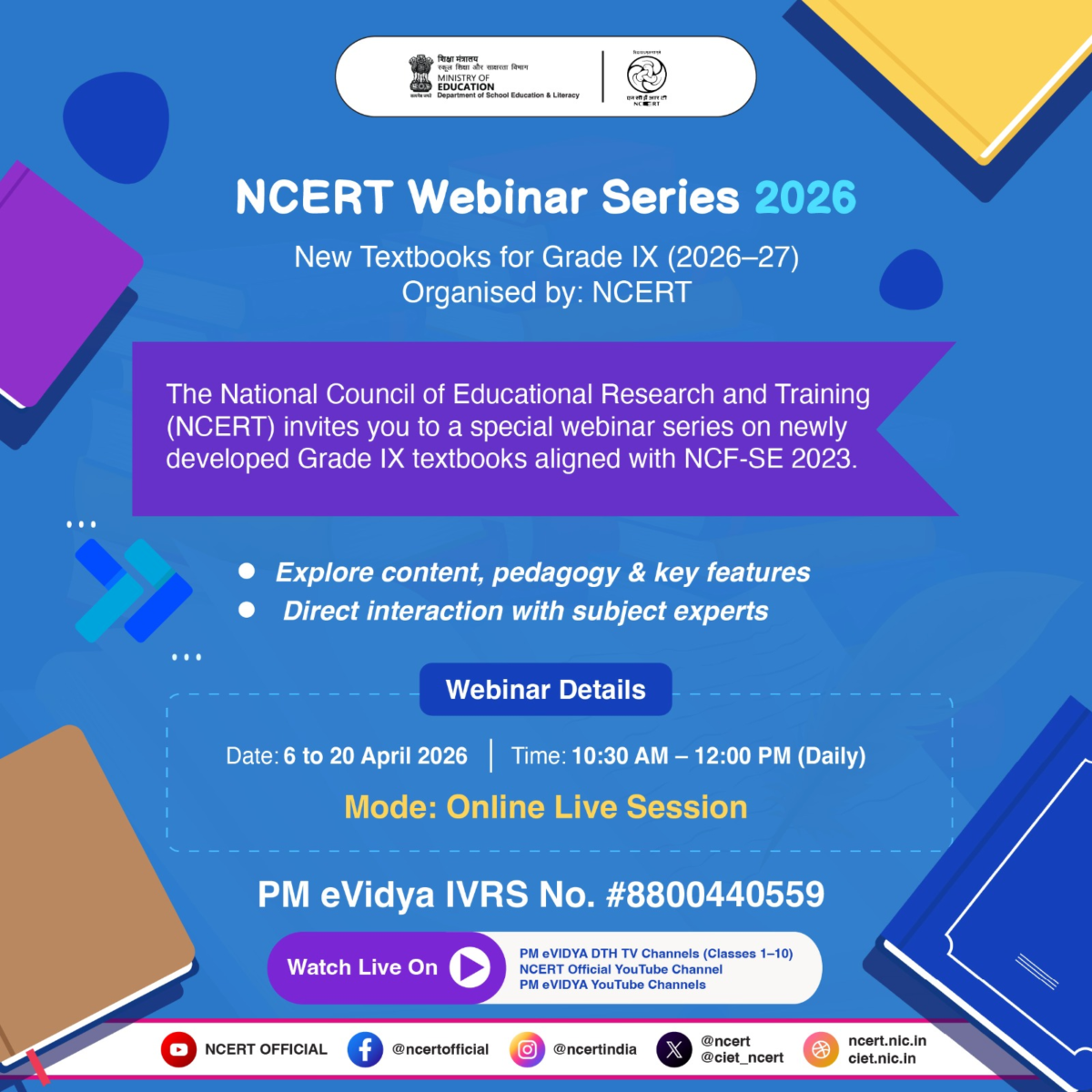
The webinar is starting from 6 April 2026, Time: 10:30 AM – 12:00 PM (Daily) and ending on 20th april.
Key Timeline Highlights
- Webinar Series Start: Monday, 6th April 2026
- Daily Session Time: 10:30 am – 12:00 pm
- Academic Session: 2026–27
- Target Audience: School Principals, Teachers, and Parents
Subject-Wise Webinar Schedule
| Date | Subject |
|---|---|
| 6 April 2026 | English |
| 7 April 2026 | Hindi |
| 8 April 2026 | Sanskrit |
| 9 April 2026 | Science |
| 10 April 2026 | Arts Education |
| 13 April 2026 | Skill Education |
| 15 April 2026 | Physical Education & Well-being |
| 16 April 2026 | Urdu |
| 17 April 2026 | Mathematics |
| 20 April 2026 | Social Science |
What This Means for Textbook Availability
- The webinar series is designed to familiarize educators and parents with the content, pedagogy, and key features of the newly developed textbooks.
- These sessions align with the National Curriculum Framework for School Education (NCF-SE) 2023, signaling a structured rollout ahead of the new academic session.
- Schools affiliated with CBSE are encouraged to disseminate this information and prepare for classroom implementation.
- Based on this timeline, the new NCERT Class 9 textbooks are expected to be available for use by either 7th April or after 20th April, coinciding with the typical start of the Indian academic year.

Please tell us about Hindi subject?? It will also change because changing of HINDI book nothing is mentioned. Plz clear about it.
Yes they Have changed the hindi book also but have not disclosed its name. NCERT says”Textbook — Hindi subject textbook for Class 9 newly developed by NCERT in accordance with the National Curriculum Framework for School Education 2023.”
This is the only latest information we have now.
It was previously communicated that the books would be available by March 20-26 . However, as March is coming to an end and April is about to begin, the books are still not available.
Cbse official session begins from 1st april 2026, may be before that books may get available online at least.
Good